You are standing in your bedroom the night before a week-long trip, an empty carry-on open on the bed, and a pile of clothes growing beside it that already looks too big for the bag. That moment is where most packing goes wrong: people choose outfits first and hope the bag will somehow hold them. Do it the other way round. Check your airline’s published carry-on size and weight limit before you pack a single thing, because limits differ between airlines and a bag that passed on one carrier can fail on another.
Start With the Bag, Not the Clothes
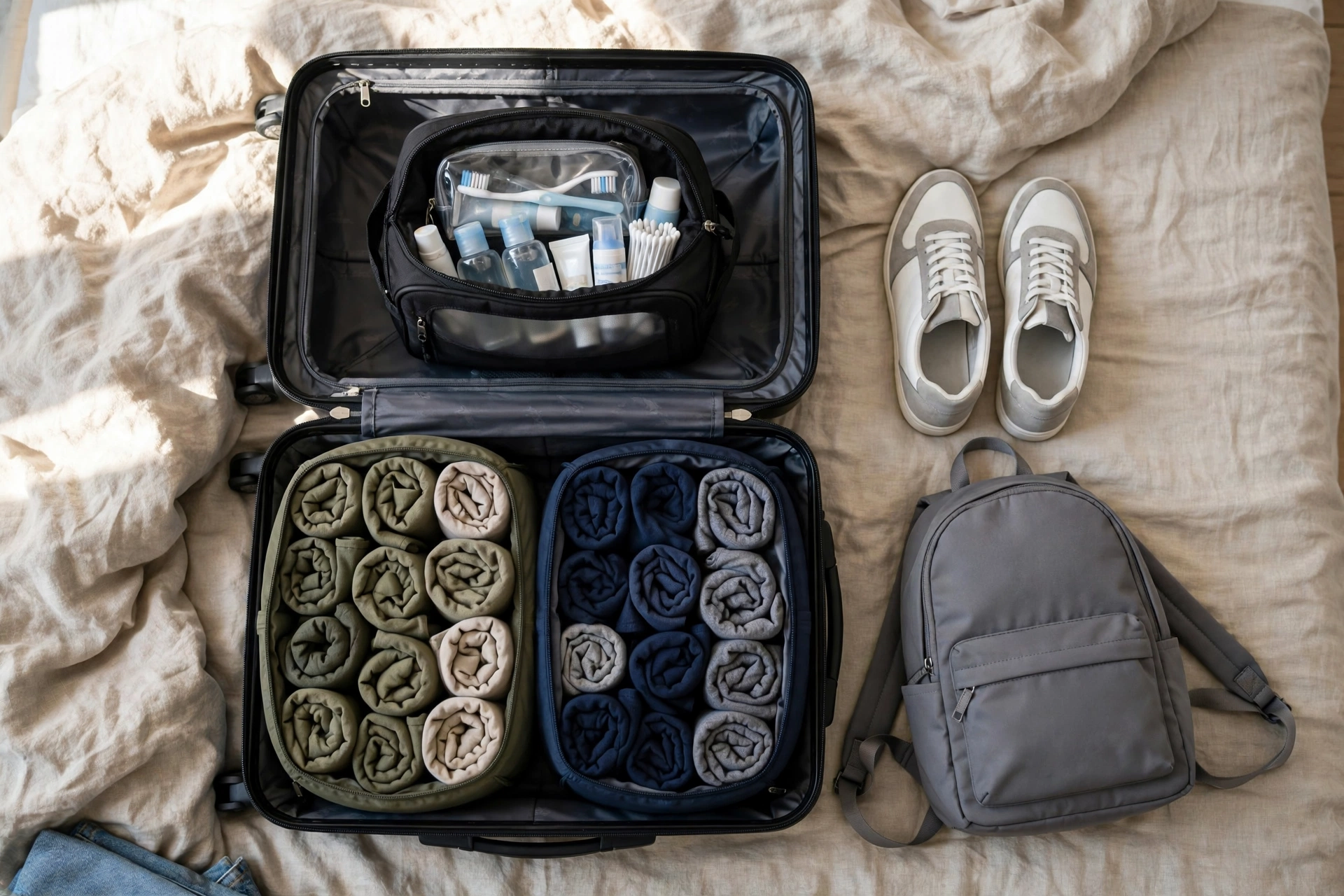
Packing cubes help here, not because they magically create space but because they divide the bag into zones you can actually find things in: tops in one cube, bottoms in another, underwear and socks in a small one. When you arrive, you lift out cubes instead of unravelling the whole bag.
Build a 7-Day Capsule Wardrobe
A week of outfits does not need seven separate outfits. It needs pieces that work together. Pick one neutral colour family — navy, black, grey or olive — and build around it so every top goes with every bottom. A workable capsule for most trips looks like this: three bottoms (for example, two pairs of trousers and one skirt, or two pairs of trousers and a pair of shorts in warm weather), five or six tops, one layer such as a light jacket or cardigan, and sleepwear. That covers seven days with repeats that nobody will notice, because the combinations change even when individual pieces repeat.
Choose fabrics that travel well. Merino wool, jersey and good-quality synthetics resist wrinkles far better than linen or stiff cotton, and they dry faster if you need to wash something in a hotel sink. Before you add any item, ask whether it goes with at least three other things in the bag; if not, leave it behind. The most common reason a carry-on overflows is not the number of days — it is the number of pieces that only match one outfit.
Roll, Fold or Cube: What Actually Works
Rolling soft items like T-shirts, knitwear and casual trousers saves space and reduces creasing, because a roll has no sharp fold lines. Structured items such as blazers and dress shirts do better folded flat on top of everything else, ideally inside a dry-cleaning bag, which lets the fabric slide rather than grip and crease.
Fill the gaps. Socks and chargers tucked inside shoes, belts coiled around the inside edge of the bag, and small items in the corners all use space that would otherwise be wasted air. Pack heavy items — shoes, toiletry bags, books — close to the wheels, so the bag stays balanced when you pull it and does not tip over in the airport.
Toiletries and the Liquids Rule
Toiletries are where carry-on packers lose the most space, because full-size bottles are heavy and bulky. Decant what you need into small refillable bottles, and switch what you can to solids: a bar of soap, a solid shampoo bar and a stick deodorant take no liquid allowance at all. A small tube of travel-size toothpaste is usually plenty for a week, and it leaves room in your liquids bag for the things that only come as liquids.
On most flights, the cabin liquids rule allows containers of 100 ml (3.4 oz) or less, all fitting inside a single clear, resealable quart-size bag, one bag per passenger. The limit applies to the size printed on the container, not how much product is left inside it, so a half-empty large bottle still fails. Keep the bag near the top of your suitcase or in an outer pocket so you can lift it out quickly at security. Rules can differ by country and airport, so check your airline’s guidance before you fly if you are carrying anything unusual, such as medicines or baby food, which often have their own exemptions.
Shoes, Tech and Your Personal Item
Shoes are the second space thief. Limit yourself to two pairs: the pair you wear on the plane, which should be your bulkiest pair, and one lighter pair packed flat in a shoe bag. Wear the heavy shoes and the jacket onto the plane and you have already freed a surprising amount of room.
Your personal item — a backpack, tote or laptop bag — is part of the system, not an afterthought. Put your valuables, medicines, travel documents, chargers and a change of underwear in it, so that even if your carry-on is gate-checked on a full flight, the things you cannot replace are still with you. Keep a phone charger and a snack in an outside pocket, reachable without opening the main bag in a crowded aisle.
A Day-by-Day Packing Checklist
Use this as a final pass once the bag is packed. If an item is not on the list and does not serve a clear purpose, it probably does not need to come.
- Days 1–2: one full outfit each, worn or packed on top for easy access on arrival.
- Days 3–5: capsule pieces that mix with the first outfits, plus the layer for cooler evenings.
- Days 6–7: the remaining combinations, and one outfit kept clean for the journey home.
- Every day: underwear and socks for each day, plus one spare set in your personal item.
- Night and laundry: sleepwear, a small laundry bag for worn clothes, and a stain-remover pen for accidents.
- Toiletries: liquids bag, toothbrush, skincare basics, any medicines in hand luggage, sunscreen if needed.
- Tech and documents: phone, charger, adapter for your destination, passport or ID, booking details, and a pen.
Mistakes That Make a Carry-On Overflow
The first mistake is packing for every possible scenario — a formal dinner, a hike, a beach day — on a trip that includes none of them. Pack for the trip you actually booked, not the trip you imagine. The second is the “just in case” pile: items added at the last minute without removing anything else. If something goes in at the last minute, something else must come out. The third is forgetting that most destinations have shops. Forgotten toothpaste, a phone charger or an umbrella can be bought on arrival; a week of clothes cannot be shrunk to fit, so spend your bag space on clothes and keep the replaceables minimal.
Finally, do a trial close and lift before you leave. Zip the bag fully, lift it as you would into an overhead bin, and walk around the room with it. If it is hard to lift or the zip strains, it is telling you something. Take out the weakest item — the one you are least likely to wear — and try again. One item removed at home is far easier than repacking at the gate.
Frequently Asked Questions
Can you really fit a week of clothes in a carry-on? Yes, for most travellers and most climates, if you pack a capsule wardrobe of mix-and-match pieces rather than seven distinct outfits. Winter trips with heavy coats are the main exception, and wearing the coat on the plane usually solves that too.
Should you roll or fold clothes in a carry-on? Roll soft, casual items to save space and avoid creases; fold structured items flat on top. Using both methods in the same bag works better than committing to one.
What should go in your personal item instead of the carry-on? Anything you cannot afford to lose or be without: documents, medicines, valuables, chargers, and a spare change of clothes. If your carry-on is gate-checked, your personal item stays with you.
Final Thoughts
Packing a carry-on for a week-long trip is less about clever tricks and more about honest choices: fewer pieces that work together, toiletries kept small, and the heavy, valuable things carried on your person. Start with the bag, build a capsule, and do one honest trial close before you leave. The reward is a trip where you walk past the baggage carousel, straight out of the airport, with everything you need already in your hand.