Picture yourself watching the sun rise over a misty tea valley, then spending the afternoon on a palm-fringed beach, and you have Sri Lanka in a single day. This small island in the Indian Ocean packs an unusual amount into a short distance: ancient cities, Buddhist temples, leopard country, hill-country railways and some of Asia’s best beaches.
This guide covers the top places to visit in Sri Lanka, with honest advice on how to combine them into one trip.
Sigiriya: the rock fortress
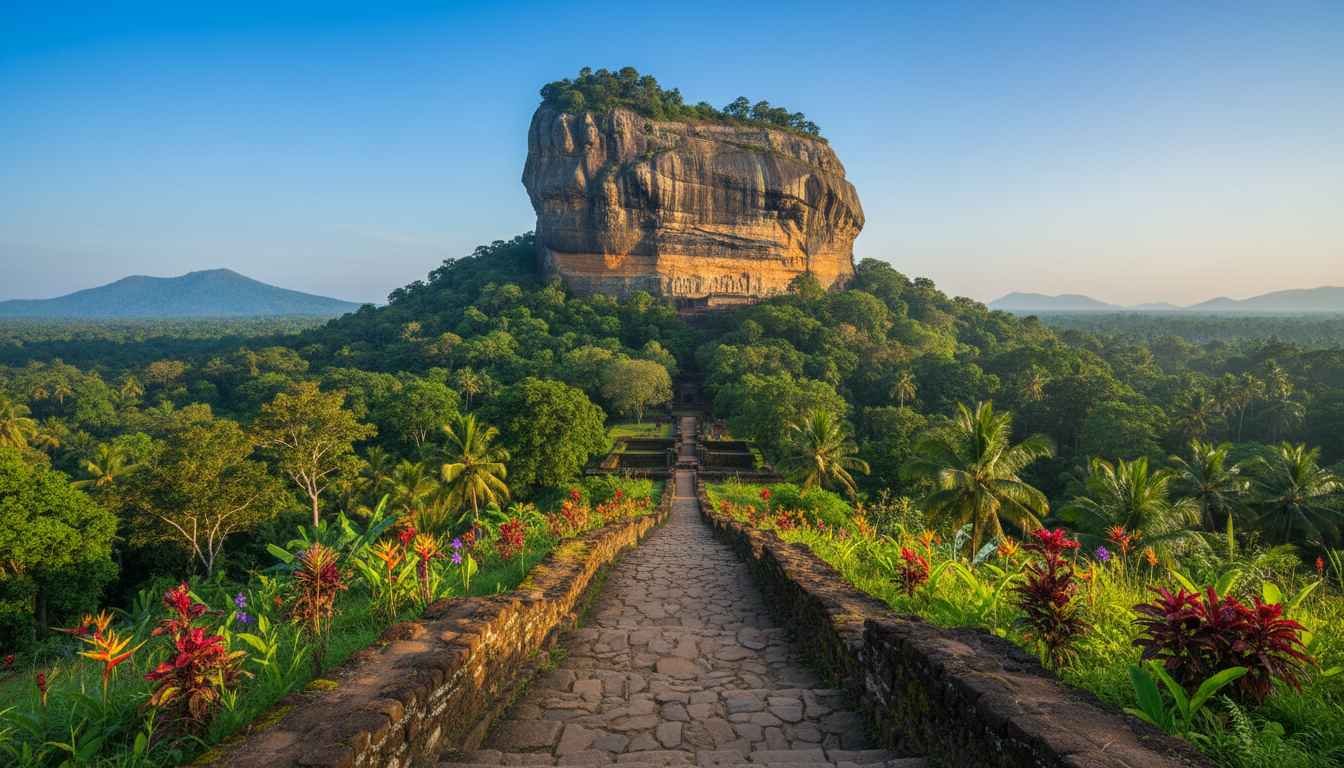
Sigiriya is Sri Lanka’s most famous sight for good reason. A massive rock rises nearly 200 metres out of the jungle, topped by the ruins of a 5th-century palace and fortress, with frescoes and a pair of giant lion’s paws guarding the final staircase. The climb takes most visitors under an hour, and the view from the summit — jungle and reservoirs stretching to the horizon — is worth every step.
Go early in the morning to avoid the heat and the crowds, wear shoes with grip for the metal staircases, and carry water. Sigiriya sits in the island’s Cultural Triangle, so it pairs naturally with the ancient cities nearby.
Anuradhapura and Polonnaruwa: the ancient cities
Anuradhapura, one of the oldest continuously inhabited cities in the world, holds dagobas, monastery ruins and the Sri Maha Bodhi tree, said to be grown from a cutting of the tree under which the Buddha attained enlightenment. It is a working sacred site as much as a ruin, so dress modestly and be respectful of worshippers.
Polonnaruwa, the later capital, is more compact and easier to explore by bicycle: the Royal Palace, the Quadrangle, and the rock-cut Gal Vihara Buddhas, four serene figures carved into a single granite face. A day at each city is enough for most visitors; two days lets you slow down.
Kandy: the Temple of the Tooth and the lake
Kandy, the last capital of the Sinhalese kings, sits around a lake in the central hills. Its centrepiece is the Temple of the Tooth (Sri Dalada Maligawa), which houses a relic of the Buddha and remains one of Buddhism’s most important shrines. Visit during the morning or evening puja ceremony, when drums and chanting fill the temple, and remember to cover shoulders and knees.
Around the temple, Kandy offers the Royal Botanic Gardens at nearby Peradeniya, a pleasant lakeside walk, and the Kandyan dance performances held most evenings. Kandy is also the starting point for the famous hill-country train to Ella — one of the most scenic rail journeys in the world, so book a reserved seat in advance.
Nuwara Eliya and Ella: tea country and the hills
Up in the hill country, Nuwara Eliya — “Little England” — sits among tea plantations at nearly 1,900 metres, with cool air, colonial-era buildings and gardens. Visit a tea factory to see how the leaves are processed, and walk the trails around Horton Plains, where World’s End is a sheer cliff with views across the southern plains on a clear morning.
Ella, further south, is the hill country’s relaxed base: the Nine Arch Bridge, Little Adam’s Peak for a short sunrise hike, and waterfalls such as Ravana Falls. The train ride between Kandy and Ella, through tea estates and tunnels, is a highlight in itself — allow a full day for it.
Yala National Park: leopards and elephants
Yala, on the south-east coast, is Sri Lanka’s best-known wildlife park and one of the best places in the world to see leopards in the wild, thanks to a relatively high density of the animals. Morning and late-afternoon safaris in an open jeep also bring elephants, sloth bears, crocodiles and a remarkable variety of birds.
Book a safari through a reputable operator, go with a driver who respects the animals’ space, and keep expectations realistic: leopards are wild animals, and a sighting is never guaranteed. The dry season, roughly February to July, generally offers the best wildlife viewing, as animals gather at waterholes.
Galle Fort, Mirissa and the south coast
Galle Fort, a UNESCO-listed walled town built by the Dutch, is one of Sri Lanka’s most atmospheric places: ramparts to walk at sunset, narrow streets of cafes and boutiques, and a lighthouse at the water’s edge. Stay inside the fort for a night if you can — it is quieter and more charming than the new town outside.
Further along the south coast, Mirissa is the classic beach town: a curved sandy bay, surfing for beginners, and whale-watching boats in season (roughly November to April for blue whales). Unawatuna, near Galle, offers calmer swimming and snorkelling, while the east coast — Trincomalee and Arugam Bay — is at its best from about May to September, when the south-west monsoon affects the other side of the island.
Colombo: the capital, in a day
Colombo is often treated as a transit stop, but it rewards a day: the Galle Face Green promenade at sunset, the National Museum for an introduction to the island’s history, Pettah’s markets for spices and textiles, and the lotus-shaped Lotus Tower for a view over the city. It is also the practical hub for trains, buses and the airport, so most trips start or end here.
Planning your trip: when to go and how to get around
Sri Lanka has two monsoon seasons, and they affect opposite coasts — which means there is almost always a good beach somewhere. The south and west coasts are driest from about December to March; the east coast is driest from about May to September. The hill country is pleasant year-round, though it can be cool and misty.
Allow at least ten days for a first trip: two days in the Cultural Triangle, two in Kandy and the hills, two on safari and the south coast, and a day in Colombo. Trains are cheap and scenic but slow, so mix them with a hired car and driver for day trips — mountain roads and local driving conditions make this more relaxing than self-driving for most visitors.
For another island escape in the same part of the world, see our guide to places to visit in the Maldives for family, and for a different kind of temple-and-palace city break, our guide to places to visit in Udaipur and nearby.
FAQ: Sri Lanka
- What are the main attractions in Sri Lanka?
Sigiriya rock fortress, the ancient cities of Anuradhapura and Polonnaruwa, Kandy’s Temple of the Tooth, the hill country around Ella and Nuwara Eliya, Yala National Park, Galle Fort and the south-coast beaches.
- When is the best time to visit Sri Lanka?
December to March suits the south and west coasts; May to September suits the east coast. The hill country is pleasant year-round.
- Is Sri Lanka suitable for families?
Yes — beaches, gentle wildlife safaris, train rides and temple visits suit families well, though the Sigiriya climb and long drives need planning with young children.
- How many days do I need?
Ten days covers the Cultural Triangle, Kandy and the hills, a safari and the south coast; two weeks allows a slower pace and the east coast as well.
Final Thoughts
Sri Lanka rewards travellers who mix its layers: an ancient fortress in the morning, a tea estate in the afternoon, and a beach at sunset. Plan around the two monsoons, take the hill-country train at least once, and give the island more time than you think it needs — its distances are short, but its sights deserve slow days.