You are standing at the packing table the night before a trip, and the one thing you cannot afford to get wrong is already giving you pause: your medicine. The clothes can be replaced, the charger can be bought again, but a missed dose, a bottle left in a checked bag, or a medicine that is not allowed where you are going can turn a good trip into a stressful one. The good news is that travelling with medication is mostly a matter of doing a few simple things in the right order, well before you reach the airport.
Start With Your Destination’s Rules, Not Your Suitcase
Every country sets its own rules for medicines brought across its border, and a medicine that is routine at home may be controlled, restricted or sold under a different name somewhere else. So the first step is research, not packing. Check the destination country’s embassy or consulate guidance, and your airline’s rules, for each medicine you take — especially anything for pain, sleep, anxiety or attention, and any medicine containing a controlled substance. Note each medicine’s generic name, not just its brand name, because brand names change from country to country while the generic name is the one officials and pharmacists abroad are most likely to recognise.
Do this check weeks before departure, not at the airport — if a medicine needs a licence or a special letter, you want time to arrange it. If you cannot confirm whether a medicine is allowed, ask your doctor or pharmacist and contact the destination embassy. Never carry medicine prescribed for someone else.
Keep Your Medicine in Your Hand Luggage
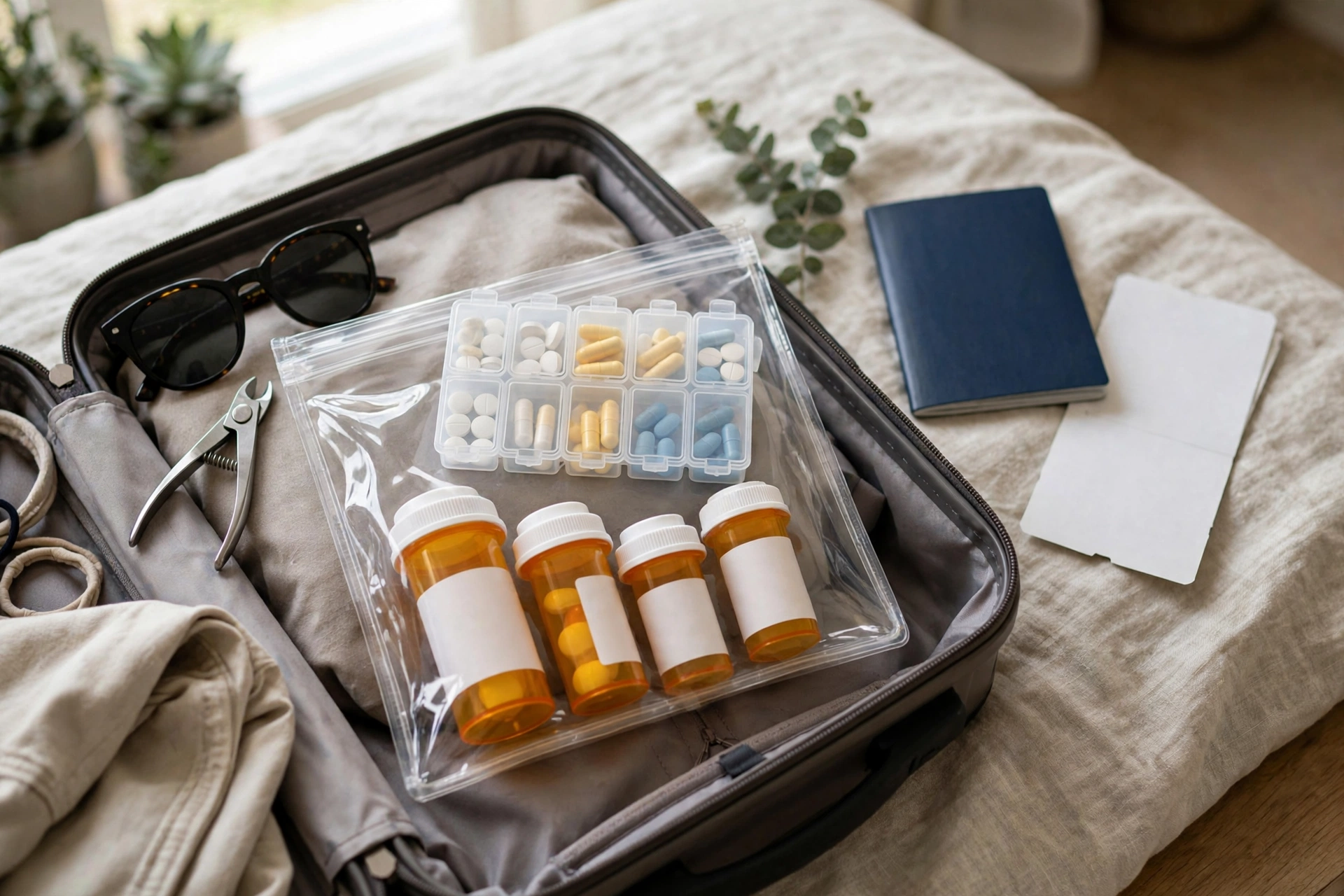
Always carry your medicine in the bag that stays with you. Checked luggage can be delayed or lost, and a bag in the hold can get very cold or very hot — neither of which is kind to medicine. Keep your treatment in your hand luggage, where you can reach it without unpacking everything at security, and carry a day or two of extra supply beyond the trip length, in case of delays.
It also helps to split your supply: keep the main supply in your hand luggage and, if you travel with a companion, a small backup in their bag where that is practical and legal, so one lost bag does not leave you without treatment. Learning how to pack a carry-on for a week-long trip will help you fit your medicine pouch, documents and essentials into one bag you can carry comfortably.
Pack in Original Packaging With Labels Intact
Keep tablets, capsules and other medicines in their original, labelled packaging, with the pharmacy label showing your name, the medicine name, the dose and the directions. Loose pills in an unlabelled container are much harder to explain at a checkpoint or a border, and they are easy to mix up yourself when you are tired or jet-lagged. A pill organiser is useful for day-to-day doses once you arrive, but carry the original packs as well, so you always have proof of what each medicine is.
Protect medicine from heat, damp and direct sunlight — avoid a hot car or a bag left in the sun. If a medicine must stay cool, use an insulated pouch, follow its label, and ask your pharmacist beforehand how long it can safely stay out of the fridge.
Carry Proof: Your Prescription and a Doctor’s Letter
Carry a copy of each prescription, and a doctor’s letter if you take a controlled medicine, an injectable, a large quantity or a liquid over the usual limit. A useful letter lists your full name, each medicine by generic name, dose and frequency, total quantity, and your travel dates and destination. Keep paper copies with your passport, plus a scan on your phone as backup — but do not rely on the phone alone, since a dead battery can leave you with nothing to show.
Ask your doctor for this letter well in advance. Some countries require a licence for a controlled-medicine supply lasting three months or more, and the letter does not override the destination country’s law — it works alongside your destination check, not instead of it. For a long trip, also ask how you would get a further supply abroad.
Liquids, Refrigerated Medicine and Medical Devices
Liquid medicine needs extra planning at security. In the United States, medically necessary liquids are exempt from the usual 3.4-ounce limit, but must be declared at the checkpoint and placed separately for screening, in reasonable quantities for the trip — see the Transportation Security Administration’s guidance for travellers with medical conditions. Rules differ by country and airport, so check every airport on your route, including connections, and pack liquid medicine where you can take it out quickly. Keep syringes, inhalers and insulin pens with the medicine they belong to, with the prescription or letter that explains them.
If your medicine needs refrigeration, tell your airline in advance and ask about its rules for cool bags and ice packs. Freeze your cool pack the night before, keep the medicine in its insulated pouch during the flight, and move it to a fridge on arrival. If you use a device such as an insulin pump or glucose monitor, carry its instructions and spare supplies, and tell security staff about it before screening.
Keep Your Routine Steady Across Time Zones
Crossing time zones can quietly disrupt a medicine routine, especially for medicines taken at fixed times. Before you travel, ask your doctor or pharmacist whether your timing should stay on your home clock or shift gradually to local time — do not guess, and do not change a dose or skip one to fit a flight schedule without advice. Once you have a plan, set phone alarms in local time for each dose, and keep a simple written schedule for the first few days, when jet lag makes it easy to forget a dose.
Keep a note of the generic names and doses in your phone and on paper. If you fall ill abroad, that note helps a local clinician understand your treatment quickly — and note any allergies too, in the local language if you can.
If Medicine Is Lost, Delayed or Taken Away
Even with careful packing, things go wrong, so have a plan before you need one. If your medicine is in delayed luggage, tell the airline at once that the bag contains essential medicine. If medicine is lost, use your prescription copy and doctor’s letter to show a local pharmacist or doctor what you need, and contact your insurer and doctor’s office about a replacement. Never buy a lookalike from an unregulated seller or borrow someone else’s medicine, even if it looks the same — the dose or ingredients may differ.
Keep your travel insurer’s and doctor’s numbers saved where you can find them without internet access, and note the nearest pharmacy to your accommodation on arrival. This article gives general travel information only, not medical advice — for decisions about your own treatment, timing or doses, always ask your doctor or pharmacist.
FAQ
Can I take prescription medicine in my hand luggage? Yes, in general — and it is the safest place for it. Keep it in original, labelled packaging, carry your prescription, and check the destination country’s rules before you fly, especially for controlled medicines.
Do I need a doctor’s letter to travel with medicine? Not always, but it is strongly recommended for controlled medicines, injectables, large quantities and liquid medicines over the usual limit. The letter should list each medicine by generic name, dose and quantity, with your travel dates and destination.
What if my medicine has a different brand name abroad? Ask a local pharmacist using the generic name, which is recognised internationally, and show your prescription or doctor’s letter. Do not substitute a different medicine without advice from a doctor or pharmacist.
Final Thoughts
Travelling with medication safely abroad comes down to three habits: check the destination’s rules before you pack, keep your medicine labelled and in your hand luggage, and carry the paperwork proving it is yours. Do those three things, keep a small extra supply, and ask your doctor or pharmacist about anything unsure before departure. Then your medicine is one less thing to worry about.