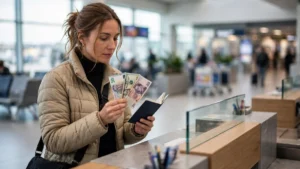
You have just landed in a new country and the taxi driver at the curb only takes cash. Ahead of you, the airport exchange desk glows with a reassuring sign and a rate that looks perfectly reasonable — until you hand over your money and count what comes back. That quiet gap is where most travellers lose money, often without ever realising it. Exchanging currency well is not complicated: it is mostly about knowing which options give you a fair rate, which ones quietly take a cut, and doing a little of the work before you leave home.

The Short Answer
For most trips, combine two things: a travel-friendly debit or multi-currency card for most spending, and ATM withdrawals in the local currency for cash. Exchange only a small amount before you travel — enough for a taxi and a coffee on arrival — and avoid airport counters and hotel desks, where rates are usually worst.
First, Know the Real Exchange Rate
Before you exchange a single note, check the mid-market rate — the rate banks use with each other, found in seconds on Google or an app such as XE. That number is your benchmark: no bureau will match it exactly, but the closer an offer is to it, the fairer the deal.
Here is the trick many exchange desks rely on: they advertise “zero commission” in large letters while quietly building their profit into a poor rate. A desk offering no commission at a rate 8 percent below the mid-market rate costs you far more than one charging a small flat fee at a rate only 1 percent below it. Always compare what you actually receive, not the headline promise. Ask “If I give you 100 dollars, how much do I get back?” and check the answer against the mid-market rate before you agree.
The Best Ways to Exchange Currency, Ranked
Not every method is equal — here they are from best to worst for a typical trip.
1. A Multi-Currency Travel Card
Cards from providers such as Wise or Revolut let you hold and spend in dozens of currencies at rates very close to the mid-market rate, and many charge little or nothing for card payments abroad. You top it up at home, spend like a local, and can usually withdraw a modest amount of cash from ATMs each month without a fee. Before your trip, check whether your card charges a foreign transaction fee and what its free ATM withdrawal limit is — limits and fees vary between providers and plans. If your current bank card already charges no foreign transaction fee, it may serve you just as well.
2. ATMs at Your Destination
Withdrawing local currency from an ATM — especially one run by a major local bank rather than a standalone machine in a tourist area — usually gives you a rate close to the mid-market rate, with your own bank adding its fee on top. The fee is often a small percentage or flat charge, so fewer, larger withdrawals usually work out cheaper than many small ones. First, always decline the ATM’s offer to convert the amount into your home currency, known as dynamic currency conversion — the ATM’s rate is almost always worse than your bank’s, so choose to be charged in the local currency. Second, avoid independent ATMs in bars, shops and tourist strips, which tend to add heavy surcharges.
3. Your Own Bank Before You Leave
Ordering foreign currency from your home bank before departure is convenient and safe, and for major currencies the rate is usually reasonable. It is the simplest way to arrive with cash in hand. The downside is that banks rarely offer the best rate, and for less common currencies they may need several days’ notice or charge a delivery fee. Use this option for your arrival cash — a day or two of spending money — rather than your whole trip budget.
4. A Reputable Exchange Bureau in Town
Licensed exchange bureaus in city centres often compete on rates and can beat both your home bank and the airport. Compare two or three, check their rate against the mid-market benchmark, and confirm there is no hidden service fee before handing over your money. Stick to licensed, clearly signed premises: a “helpful stranger” offering a great rate on the street is not a bargain — the notes may be counterfeit or short-counted.
5. Airport Counters and Hotel Desks — Last Resort
Airport exchange counters and hotel desks know you are in a hurry and have few alternatives, and their rates reflect that — the gap from the mid-market rate is often the widest of any option. Use them only for a small emergency amount, and exchange the rest later in town, where competition keeps rates honest.
How Much Cash Should You Actually Carry?
Most travellers now pay by card for hotels, restaurants and transport, so cash is mainly for taxis, markets, tips and small shops. A sensible rule is to carry enough local cash for one to two days of small expenses, and top up from ATMs as you go. That keeps losses small if cash is lost or stolen, and avoids coming home with foreign notes that cost you again to change back. Leftover coins are almost never accepted for exchange, so spend them before you leave or keep a few as souvenirs — and change leftover notes back only in larger amounts, since a second round of fees eats small sums quickly.
Four Traps That Quietly Eat Your Money
Dynamic currency conversion. Whenever a card machine or ATM asks whether you want to pay in your home currency, say no — paying in the local currency lets your own bank convert at the better rate, as explained above.
“No commission” signs. Commission-free does not mean fee-free — the cost is usually hidden in the rate, so compare the amount you receive, not the sign.
Exchanging twice. Changing money into one currency and then into another doubles your losses — go directly from your home currency to your destination currency whenever possible.
Street exchangers and too-good rates. Anyone offering a rate far better than every licensed bureau is not being generous — tourist scams often start with a friendly currency offer, so walk away from unofficial exchanges, however convincing they sound.
Keeping Your Exchanged Cash Safe
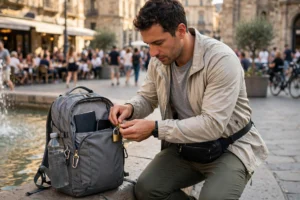
Once you have your local currency, split it between your wallet and a secure spot in your luggage, keep larger notes out of sight, and avoid counting money in public. A money belt or an inner jacket pocket beats a back pocket. For the full routine, our guide to keeping valuables safe while backpacking covers the habits that work on any kind of trip.
Frequently Asked Questions
Should I exchange money before I travel or after I arrive?
Do a little of both. Exchange a small amount at home so you arrive with cash for the first few hours, then use local ATMs or a travel card for the rest — you will almost always get a better rate at your destination than at an airport counter.
Is it better to use cash or a card abroad?
Cards usually win for larger payments, because a good travel card converts near the mid-market rate. Cash still matters for taxis, markets, tips and small businesses that do not take cards, so carry some of both.
What is the cheapest way to get foreign currency?
For most travellers, a fee-free travel card for spending plus occasional withdrawals from a major bank’s ATM gives the lowest overall cost — but compare your own bank’s foreign transaction and ATM fees first, because the cheapest option depends on your card.
Final Thoughts
Exchanging currency well comes down to three habits: check the real rate before you go, use a travel card and local ATMs for most of your money, and compare what you actually receive instead of trusting a “no commission” sign. The savings on a single trip may look small — a few dollars here, a few there — but over a week of spending they add up to a dinner or a day trip. Spend five minutes on your money before you travel, and your trip budget will stretch a little further.